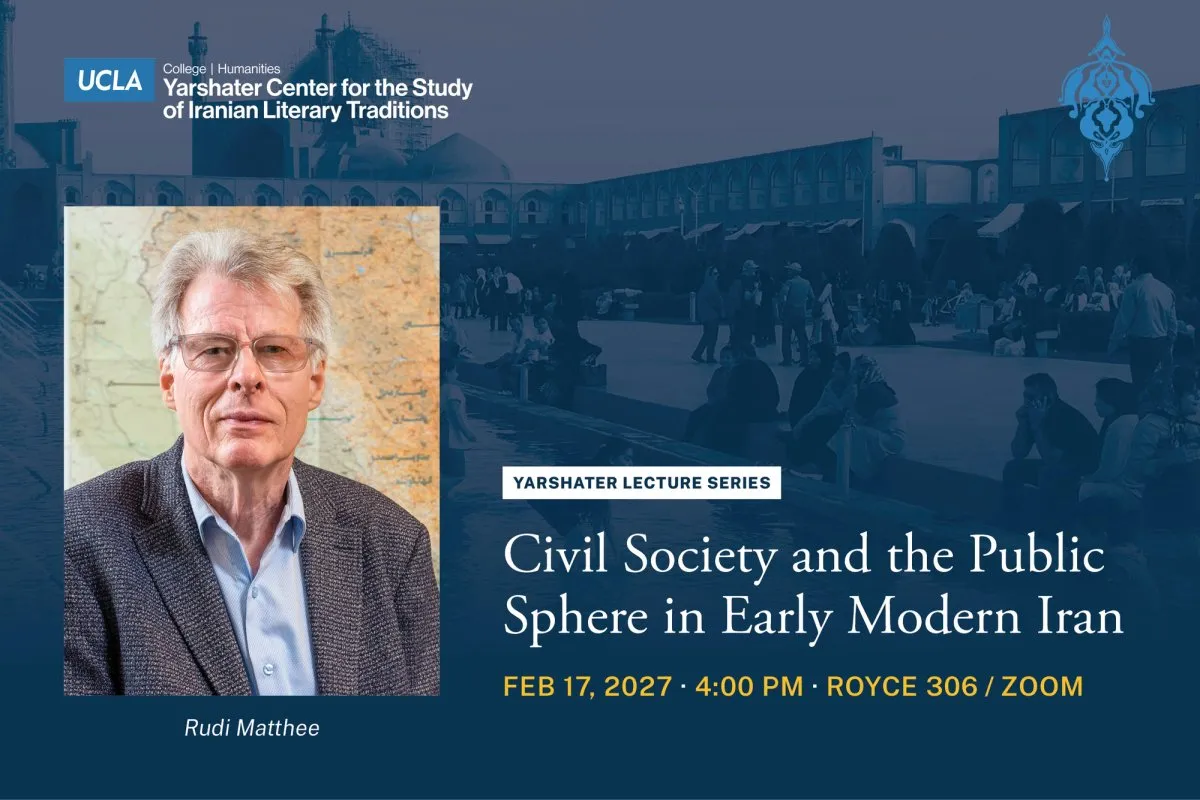
Rudi Matthee: Civil Society and the Public Sphere in Early Modern Iran
Abstract
Civil Society and the Public Sphere in Early Modern Iran
An old Orientalist trope going back to early modern Western observers holds that a despotic state assisted by a suffocating faith, Islam, crowded out manifestations of public life in Islamic societies by stifling popular self-articulation, preventing the emergence of civic pride, and disallowing civil disobedience beyond bread riots. This presentation takes issue with this portrayal of a populace cowering in fear in the face of overpowering authority and extends existing revisionist scholarship on the issue to Safavid and Qajar Iran, with the argument that Iran has a strong tradition of civic mindedness. This comes out in 1.) the remarkably accessible Safavid shah, 2.) the urban maydan as an agora-like public space, 3.) a culture that fostered intellectual debate and even countenanced freedom of conscience, 4.) the centrality of justice and its pursuit in Iranian mythology, 5.) epic poetry and manuals of manners and morals, and 6.) the civic pride and communal historical consciousness that helped the elites of the scattered oases on the Iranian plateau preserve local self-rule and social purpose. Early modern Iran, therefore, knew an implicit “social contract,” between subjects, who, though not citizens in the modern sense of the word, claimed rights, including the right to dissent. Their government, which, though often despotic, was bound by limits that, of needs, it had to observe.
About the Speaker

Rudi Matthee
University of Delaware
Rudi Matthee obtained both a BA and an MA in Oriental Languages and Cultures from Utrecht University, the Netherlands, and a PhD in Islamic Studies from the University of California, Los Angeles. He serves as the John and Dorothy Munroe Distinguished Professor of Middle Eastern History at the University of Delaware. He has authored five books, most recently Angels Tapping at the Wine-shop’s Door: A History of Alcohol in the Islamic World (Oxford UP, 2023), four of which received awards. Matthee also has (co-)edited six volumes, most recently The Safavid World (Routledge, 2021). He currently serves as the President of the Persian Heritage Foundation. He is a two-time fellow at the Institute for Advanced Study, Princeton (2002–2003 and 2017). He received a Guggenheim Fellowship in 2026.