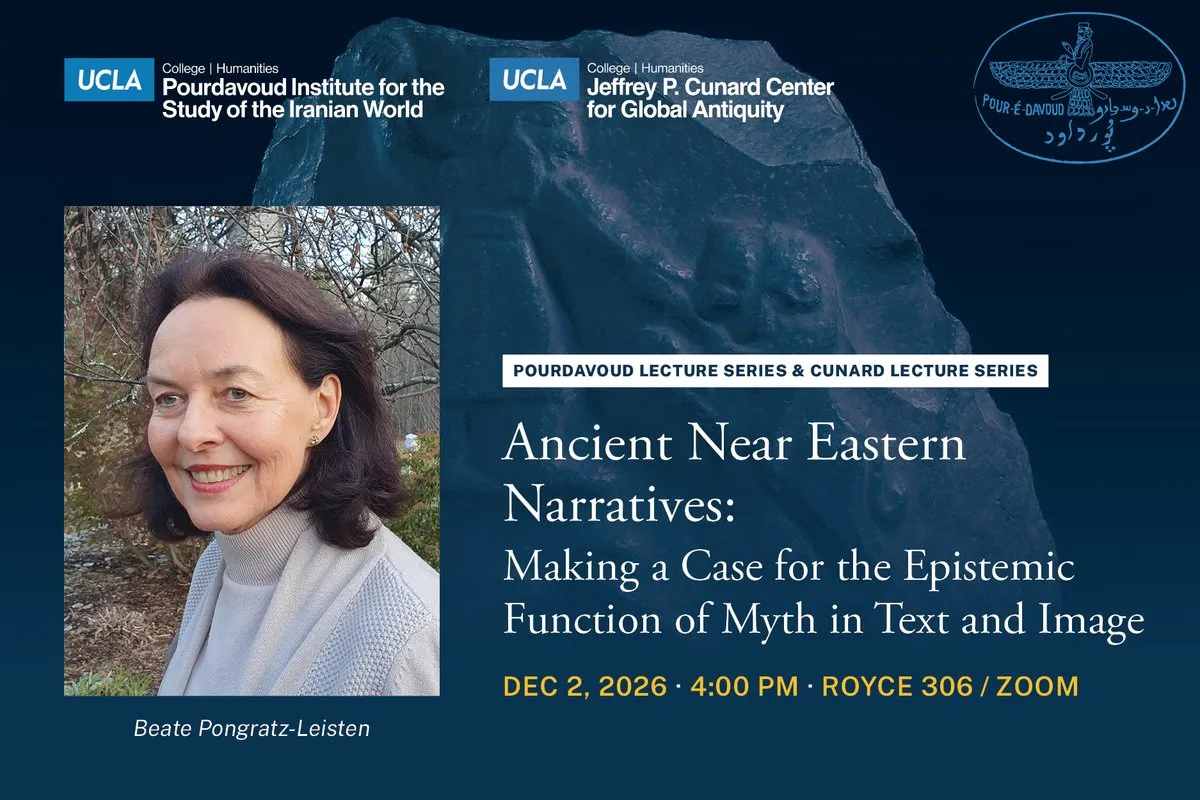
Beate Pongratz-Leisten: Ancient Near Eastern Narratives
Co-Sponsored by:
UCLA Pourdavoud Institute
UCLA Cunard Center
Abstract
Ancient Near Eastern Narratives: Making a Case for the Epistemic Function of Myth in Text and Image
Throughout its history, Assyriological scholarship has turned to exploring many facets of ancient epistemology, including lexical lists, divinatory knowledge, medicine, mathematics, pharmaceutical knowledge, legal compendia, and commentary literature. Two domains of knowledge production conspicuously have remained left out of the picture: mythic narratives and the image.
The book Myth, Text, and Image in Ancient Mesopotamia: A Narrative Reading of the World makes a case for establishing human thinking-in-images as an essential part of ancient Mesopotamian reasoning based in the fact that in the human mind, imagistic thinking exists alongside rational logical thought. Due to their orientational and expository nature, story-telling and myth-making can claim their rightful place as systems of knowledge. Mythic narrative as realized in text and image is an analytical tool that offers insight into life experiences, conveys cultural knowledge, provides potential models for decision-making and behavior, and/or explains existing cultic realities as well as socio-political structures and hierarchies.
Drawing on insights from cognitive narratology, cognitive semiotics, and visual studies, the book explores how myth as episteme, that is, as a system of knowledge and part of cognitive and cultural experience, serves as an explanatory system and a way of world-making in that it not only reflects, but also constitutes reality. Past events or core metaphors—mythical or historical—are reactivated in the memory, while the inclination for emplotment creates coherence and meaning for the present. The process of reworking and re-actualization in text and image is selective and innovative, forever interpreting, constructing, re-inventing, and reconstructing the past and establishing tropes from the stream of tradition. Narrative knowledge is not simply a recollection of the past, but a product of narrative understanding, a retrospective, interpretative composition, viewing, or reception.
About the Speaker

Beate Pongratz-Leisten
New York University
Beate Pongratz-Leisten is Professor at the Institute for the Study of the Ancient World, New York University. She is a cultural historian of the Ancient Near East. Her research interests include the political, intellectual, and religious history of Western Asia, materialities of culture, literature, formation of textual communities, transmission of cultural memory, ritual performance and ritual texts, text and image, and knowledge production. Her publications include several books on the cultural and religious history of ancient Mesopotamia, among them more recently Reconsidering the Concept of Revolutionary Monotheism (2011), Religion and Ideology in Assyria (2015), a volume of collected articles Materiality of Divine Agency (2015) co-edited with Karen Sonik, and Myth, Text, and Image: A Narrative Reading of the World (2026). Currently she is working on a monograph, Image and Knowledge Production: The Social Construction of the Visual and the Construction of the Visual in Early Mesopotamia. Together with her Co-PI Elizabeth Knott, she is heading the edition of Akkadian Rituals for the series Writings from the Ancient World, and she is editor-in-chief of Ancient Literature for Old Testament Studies.